
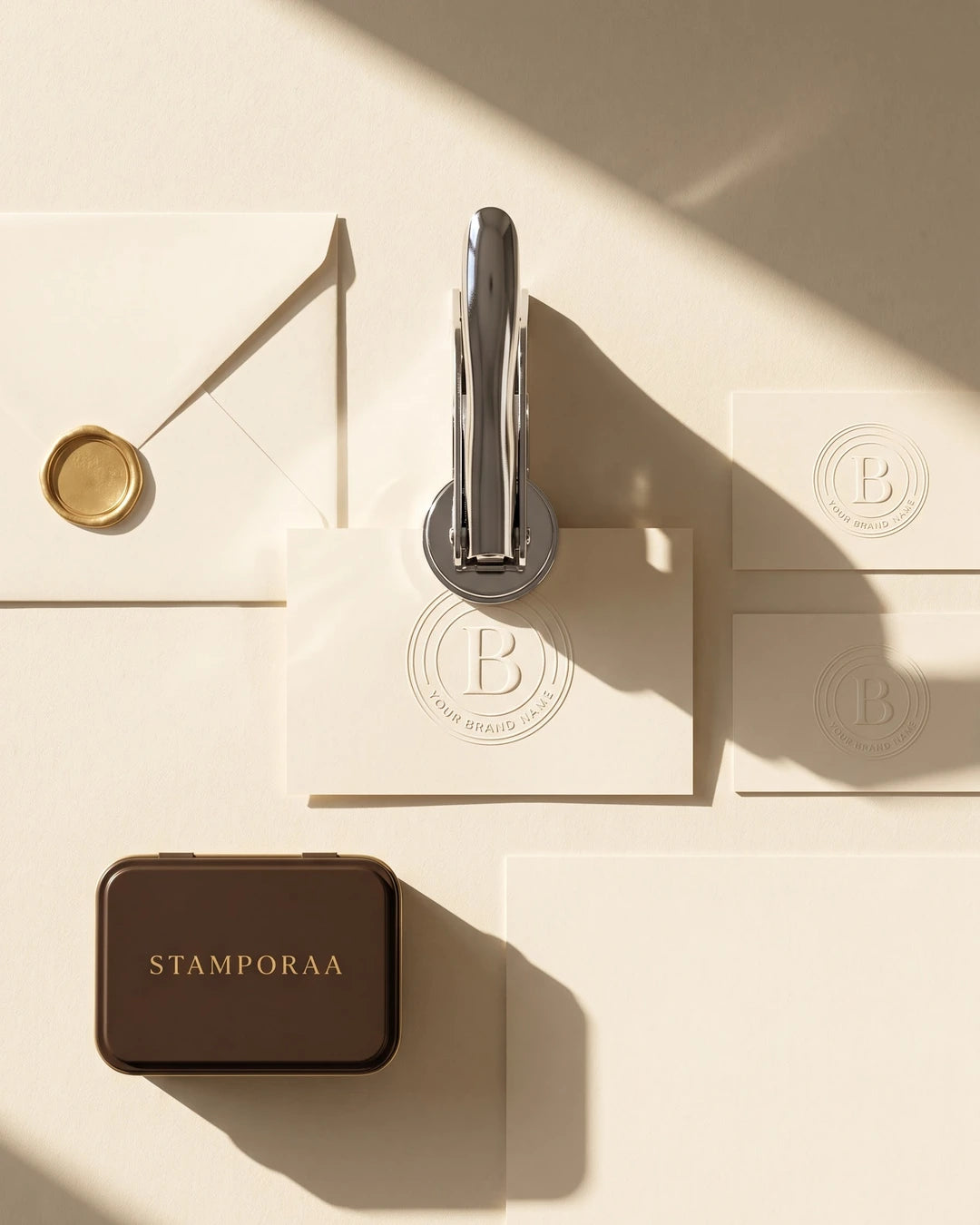


A signature embosser takes your name, initials or actual handwritten signature and turns it into a raised seal you can press into any sheet of paper. It is the tactile version of signing, and it cannot be copied with a photocopier or a phone scan.
People use one for three broad reasons: to authenticate documents, to mark ownership of books and papers, and to give personal stationery a finish that printing cannot match.
Two kinds of signature seal
A name set in type. Your name in a chosen font, usually inside a circular border with a phrase such as "From the library of" or "From the treasures of". This is what most of our designed embossers do, and it is the cleanest option for a first embosser. The Signature Treasures Seal uses the phrase "From the treasures of" with your name at the centre.
Your real handwritten signature. We cut your own signature into the plate. This is done on the Impressa custom identity embosser, which takes your own artwork rather than a fixed design.
What a handwritten signature needs to emboss well
A signature that looks fine in ink can fail as an embossed seal. The plate reshapes paper, it does not draw lines, so a few rules apply.
- Sign large, then we scale down. Sign on plain white paper with a black felt tip or gel pen, about 8 to 10 cm wide. Photograph or scan it straight on, in good light.
- Thicker strokes survive. A hairline ballpoint signature shrinks to lines too fine to hold a relief. A bolder pen gives the plate something to press.
- Loops that nearly close will fill in. If two strokes almost touch in the original, they will merge once reduced to 40 mm.
- Add a border. A signature alone floats. A thin circle or your printed name underneath makes it read as a seal rather than a smudge.
Send the file with your order and we will tell you before cutting if anything needs thickening.
40 mm or 50 mm
Every designed embosser in our range comes in two plate sizes: 40 mm at ₹1,669 and 50 mm at ₹2,869.
- 40 mm suits book pages, notebooks, envelopes and letters. It sits neatly in a corner and holds a name comfortably.
- 50 mm gives a signature room to breathe. Choose it if your signature is long, if you want a phrase and a signature together, or if the seal goes on A4 certificates where a larger mark looks proportionate.
Where a signature seal earns its place
- Certificates and letters of recommendation from a coaching institute, studio or clinic. The raised mark signals that the original came from you.
- Artwork and prints. Artists emboss the margin of a print next to the pencil signature and edition number.
- Personal letters and cards, sealed at the bottom instead of signed.
- Books you have written or illustrated, signed and sealed for readers at launches.
- A gift for someone who has just qualified as a doctor, lawyer, architect or CA, and will sign a lot of paper from now on.
Legal documents, briefly
An embossed signature seal is a mark of origin, not a substitute for a wet signature where the law requires one. Use it alongside your signature on documents, not instead of it. If you need a seal for company or professional filings, check the requirement with your CA or advocate first.
Common questions
Can I use a digital signature image?
Yes, if it is sharp and high resolution. A small signature cropped from a PDF usually is not. A fresh photo of a pen signature on white paper works better.
Does the embosser need ink?
No. It presses a raised mark. For a gold finish, emboss onto gold seal cards and apply them. More options in paper embosser with ink.
Will I see the design before it is made?
Yes. You approve the design first. Dispatch is usually same day to 2 to 3 days after approval.
Can the same plate carry my name and my signature?
Yes, and the 50 mm size is the better choice for that layout.
Compare an embossed signature with an inked one in embosser vs rubber stamp, or browse every design in the paper embossers collection.

