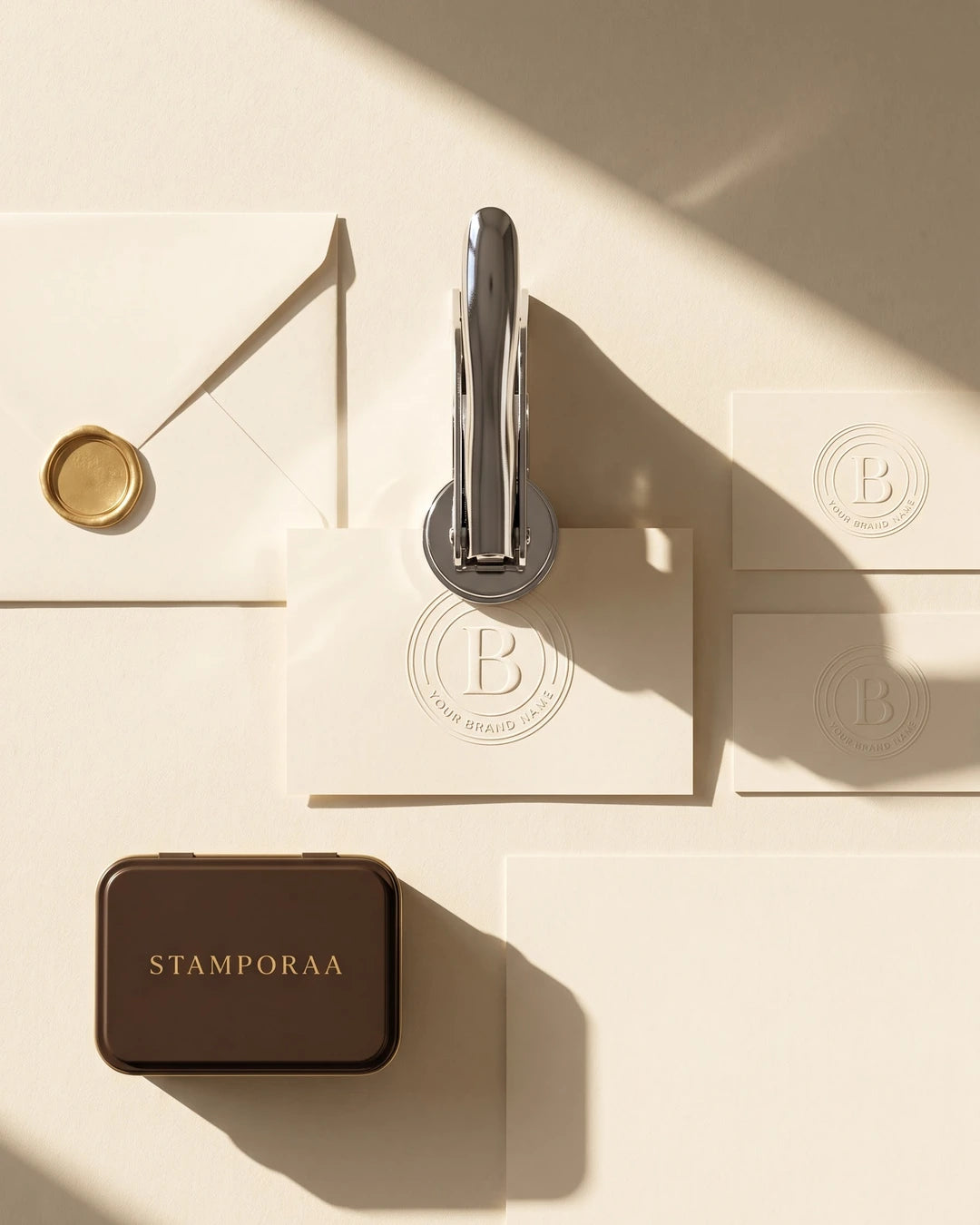


A signature proves who wrote the book. An embossed seal beside it proves that the author means it. For a self-published novelist, a poet with a small press run or a writer who hand-delivers copies, an author's embosser is one of the cheapest ways to make a copy feel special.
Where writers use one
- Signed first editions. The seal goes on the title page next to the signature.
- Review copies and gifts to critics, bloggers and libraries carry the same mark.
- Launch invitations and thank-you cards get a seal on the card.
- Manuscripts and submissions sent by post look professional.
- Your own library gets a seal for the books you lend.
Designing an author seal
- Your name or pen name in an arc with a small mark in the centre.
- A motif that fits your genre. The designer has book, moon, floral and other designs to start from.
- A signature-style seal, based on your own handwriting. See our guide on signature embossers.
For a gold detail, emboss a gold seal card and stick it inside the front cover.
A gift for a writer
For the writer in your life, a personalised embosser is more than a pen. Pair it with a journal. Our embosser gift guide shows how to order without spoiling the surprise.
Plate layouts for authors
- Author seal. Your name or pen name in a ring, with a small book, quill or leaf in the centre.
- Series seal. The series title in the top arc and your name in the bottom arc, for authors with several books.
- Press or imprint seal. A small publisher's name in a ring, for a self-published imprint.
- Library seal. "From the library of" and your name, for your personal collection.
Ways writers use the seal
- Launch day. Sign the first fifty copies and seal them. Readers who get a numbered, sealed copy talk about it.
- Review and library copies. A sealed note tucked inside each one looks deliberate.
- Newsletter subscribers. Send a sealed postcard as a thank-you to early supporters.
- Manuscripts. Seal the title page of a printed manuscript sent to an agent or a press.
Mistakes to avoid
- Embossing on glossy dust jackets. Seal the title page or endpaper, which are plain paper.
- Using several different marks. One mark across all your books builds recognition.
- Making the plate too detailed. A simple mark presses cleanly and reads at a glance.
40 mm or 50 mm: which size
| Size | Price | Best for |
|---|---|---|
| 40 mm | ₹1,669 | A name or short firm name in an arc, one small mark in the centre |
| 50 mm | ₹2,869 | Longer names, a registration or enrolment number, finer logo detail |
| Gold seal cards, set of 20 | ₹299 | A gold finish, or sealing paper that is too thick to emboss directly |
As a rule of thumb, count the characters you want on the plate. Up to about twenty fits 40 mm comfortably. Beyond that, choose 50 mm.
How to order
- Open the Impressa custom identity embosser. It takes your own name, text or logo. The 40 mm size is ₹1,669 and the 50 mm size is ₹2,869.
- Choose your text, or switch on the image option and upload your logo. You can also build a preview in the embosser designer.
- Approve the design proof we send. Dispatch is usually same day to 2 to 3 days after approval.
Common questions
Can I use a pen name?
Yes. The plate carries whatever text you give us.
Will it work on book paper?
It works on normal paper up to about 180 gsm, so title pages and endpapers take it well. Glossy coated stock is not ideal.
Can I get the seal in gold?
Yes, with a gold seal card.
Can I number signed copies?
You can write the number by hand beside the seal. The plate itself carries fixed text.
Can a publisher order several plates?
Yes, for each author or imprint. Tell us the quantity.
Is it a good gift for a writer?
Yes. Pair it with a notebook or a pen. See our embosser gift guide.
More in this series
The same embosser works differently on every desk. Read the guide for your profession:
- Doctors and dentists
- Lawyers and advocates
- Chartered accountants
- Engineers
- Architects and interior designers
- Teachers and professors
- Consultants, coaches and freelancers
New to embossers? Start with how to use a paper embosser, or compare it with a rubber stamp in embosser vs rubber stamp.

